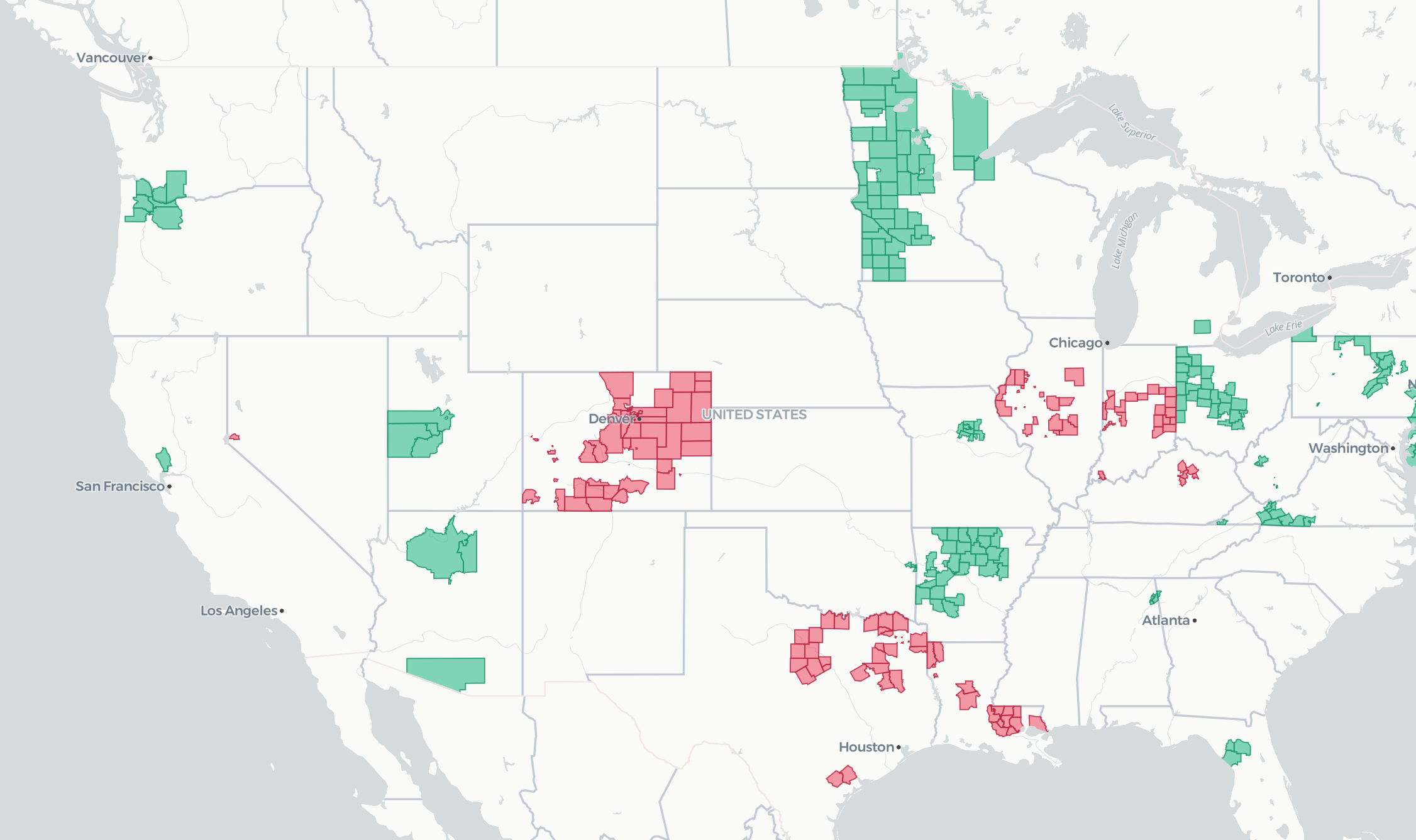
On June 10, the IRS released Notice 2026-39, its annual revision to the federal energy community designations that carry the 10% bonus credit. By our comparison of the 2025 and 2026 guidance, 160 counties gained eligibility, 139 lost it, and 39 census tracts newly qualified through coal closures.
We did a deep dive to better understand what drove the change, and nearly all of it reduces to two mechanisms pulling in opposite directions: an annual unemployment test that swings whole regions on and off the list, and a permanent coal-closure layer that only ever grows.
The fossil-fuel half: a test that resets every year
Fossil-fuel eligibility is recalculated every year: among areas with a qualifying history of fossil-fuel employment, a county stays eligible only while its unemployment rate sits at or above the national average. That average has risen steadily, from 3.6% in 2023 to 4.0% in 2024 to roughly 4.3% in 2025. As the threshold climbs, a region can lose its designation simply by outperforming the broader labor market. Colorado lost 43 of its 64 counties, as the Denver, Colorado Springs, Boulder, Fort Collins, and Grand Junction markets all dropped below the threshold. Texas is the starkest illustration: the nation's largest oil and gas producer shed 31 counties across North and East Texas, not for any decline in energy activity but because the state's labor market outpaced the national average.
Mid-size metros with deep institutional anchors followed: the universities, hospitals, state capitals, and military bases that keep employment steady through a downturn. Because the test is relative, these markets fell off not by weakening but by staying healthy while the country softened. Lexington, Kentucky, home to the University of Kentucky and the Toyota plant in nearby Georgetown, ran near 2.9% unemployment, far below the 4.3% national line. Evansville, Indiana; Baton Rouge, Louisiana, the state capital and home to LSU; and Shreveport, Louisiana, anchored by Barksdale Air Force Base, each settled just below the threshold. None stopped being fossil-fuel economies; their workers simply fared better than the national average, which is all the test measures.
The gains are the inverse. The Philadelphia metropolitan area qualified as a single unit across four states (Pennsylvania, New Jersey, Delaware, and Maryland), led by Delaware, whose jobless rate rose more than that of any state year over year. Portland qualified across Oregon and Washington following Intel's layoffs.
Minnesota was the biggest single-state gain in the country, going from zero qualifying counties in 2025 to 44 in 2026. Almost all are rural rather than metro, and they moved as whole regions: when soft farm and manufacturing labor markets lifted non-metro unemployment above the national line, entire swaths of the state flipped on at once. Minnesota is no oil state, but the Enbridge crude-oil pipeline corridor running across the north clears the employment threshold, and that eligibility had sat dormant for years, waiting only on unemployment to turn.
The coal-closure half: permanent by design
Coal-closure designations operate on a more durable basis: once a tract qualifies, it remains eligible permanently. The largest addition this cycle came from Utah, where the Intermountain Power Plant in Delta retired 1,800 megawatts of coal capacity, the single largest retirement in the country last year, conferring permanent eligibility on the surrounding tracts. In New Hampshire, the retirement of Schiller Station in Portsmouth qualified nearby tracts and, because eligibility extends to directly adjoining tracts, reached across the river into Kittery, Maine.
A further set of additions were not new closures but data corrections: the IRS newly identified these tracts as coal closures after correcting the recorded location of earlier coal-mine closures in central Missouri, northeast Alabama, and northwest Georgia, and made them eligible retroactively to January 1, 2023.
Why small cities fall out of eligibility while the countryside holds
The interaction of the two categories produces the period's most counterintuitive outcome. Coal-closure eligibility attaches to rural census tracts that are large in area but small in population, so it tends to encircle a coal region while bypassing the dense urban core at its center, whose tracts do not adjoin the closure. That core typically qualified only through the annually tested fossil-fuel category. When a metro's unemployment improves and it leaves that list, the rural surroundings retain their permanent coal-closure status, while the city center, holding no independent basis for eligibility, loses it entirely. The result is a city-shaped gap in eligibility within a region that otherwise retains it. Western Colorado is the clearest case: Grand Junction, Montrose, and Delta all lost their designations in 2026, while the rural land around them, anchored by permanent coal-closure tracts, stays eligible. The population center proves to be the most exposed parcel on the map, precisely because its eligibility rested on the one test that resets each year.
What this means for your project
For a site that lost eligibility, the first question is the construction start date: a project that began construction while its location still qualified retains the designation. For a site that gained eligibility under the fossil-fuel category, the designation should not be treated as durable, as it rests on a test that is rerun each year. The prudent course is to commence construction while the location qualifies and secure the bonus while it remains available.
.svg)


.svg)

